Wednesday, December 16, 2015

Why I Love Twitter


By Bianca Eugene

Twitter, according to http://whatis.techtarget.com/definition/Twitter, is a free microblogging site (which is a social media site where a user can make short and frequent posts) that allows you to read and write up to 140 character messages that are called “tweets.” Many people wonder, “Why does Twitter only allow 140 characters?” and/or “Why won’t they allow us to tweet more?”
This is because the creators initially were focusing on making an app for mobile phones and 140 characters was the maximum amount cell phone companies had as the short message service, or SMS. As the years moved along, they kept their initial standard, and still currently do. The amount of characters for a text to be referred to as an SMS as of today is 160.

Twitter’s headquarters is in San Francisco, CA, and of course is available in many other countries worldwide. 

In February of 2006, Jack Dorsey, Evan Williams, Biz Stone, and Noah Glass first discussed the concept of making cell phone text messages statuses, or SMS. The name “Twttr” was chosen by Glass in March of 2006. Today, the social media site is spelled “Twitter.” Both names are pronounced the same way, but the spelling is different. Dorsey sent out the first tweet on March 21 at 9:50 pm, testing out his new creation. He tweeted: “just setting up my twttr.”
March of 2007 brought a new milestone for the newly developed phenomenon; tweets rose from 20,000 a day to 60,000. More and more people started using the new entertainment system, making the creators and co-creators very successful.

When Twitter first began, their logo, a blue bird, was called “Larry the Bird.” Now, the logo is referred to as “The Twitter Bird.”  Back then, people had limited access to Twitter because technology wasn’t as advanced as it is now, but today the application (app) is available on iPhones, Androids, tablets, etc.
The most retweeted tweet was a “selfie” picture Ellen DeGeneres tweeted of herself and other famous people at the Oscars. Twitter makes money from the many advertisements you see on the sides, or on your feed. Sometimes, the ads are in the trending topics section, which garners more attention.

In my opinion, Twitter is so popular because it’s easy to use, you can be up to date with all types of news, celebrities use the app so you can stay connected and get to know them better in a sense, and it’s just entertaining in general. When I’m bored, I go onto Twitter and am automatically entertained. People tweet and retweet funny videos of various things, and I sometimes don’t even see when the time passes by.

Bianca Eugene is a freshman and Journalism major at St. Thomas Aquinas College. She is a contributor to the campus newspaper, The Thoma.

 Sources

http://twitter.about.com/od/Twitter-Basics/a/The-Real-History-Of-Twitter-In-Brief.htm
http://searchmobilecomputing.techtarget.com/definition/Short-Message-Service
https://www.youtube.com/watch?v=NzRkszaGBbY


 

Tuesday, December 15, 2015

My Favorite Media: Magazines


By Gianna Pisano

Francis Bacon, a British philosopher, once said that the printing press changed the whole face and state of things throughout the world. In 1440, when Johannes Gutenberg invented the printing press, he made it possible for knowledge and information to be mass produced for the first time in history. As a result, in 1663, one of the earliest forms of a magazine was created by Johann Rist, a German theologian and poet. It was called Erbauliche Monaths-Unterredungen, which means Edifying Monthly Discussions, and contained mostly scholarly articles and summarized books. It was very well received by young intellectuals of the time, and lasted for about five years.
 
A few years later, in 1672, a French writer and playwright, Jean Donneau de Vizé, produced the first amusement periodical in France named Le Mercure Galant. It included songs, news, gossip, and short poems, and was looked down upon by other writers for its lack of intellectual content. Nonetheless, it became very popular in France and was in publication for several years.

Beginning in the 1700s, magazines started to become more prominent across Europe, and in 1741, the first magazines were published in America. Benjamin Franklin and Andrew Bradford were Philadelphia publishers who owned rival newspapers and were competing to produce the first American magazine. Bradford produced his magazine three days before Franklin, but neither was particularly successful, with both only lasting a few months.
 
Despite this fact, however, magazines became very popular across America. By the early 1800s, nearly one hundred magazines were in publication in America with one of the most influential being Pennsylvania Magazine, edited by Thomas Paine.

As Americas magazine market began to grow increasingly popular by the late 1800s, special-interest magazines started getting created. Numerous magazines were published that were specialized for professionals, including artists, musicians, and lawyers.
 
Additionally, literary review magazines, which contained fiction stories and essays by the most well-known writers of the time period, became more desired. Starting in the 1900s, magazines that were focused upon aspects such as parenting, travel, and fashion began to be published, as well as magazines that were aimed at men, women, and teens. For example, Seventeen magazine was founded in 1944, and it was the first to be aimed solely at teenage girls. Today, the top five most popular magazines are all for a specific audience, being AARP, Game Informer, Better Homes & Gardens, Good Housekeeping, and National Geographic.

Magazines are my favorite media for numerous reasons. First, they have been around to provide people with news since the 1600s and I like seeing how they have evolved throughout time. I also like how, especially today, there are so many specialized types of magazines that I feel at least one type appeals to everyone. Finally, I feel like, among other forms of media, magazines have the ability to look into social issues and make them known to the public.
 
As for my favorite types of magazines, Im really into entertainment and fashion. I have a subscription to People, but I also love Elle, The Hollywood Reporter, Marie Claire, Vogue, Entertainment Weekly and InStyle, to name a few. I also like Time, The New Yorker, and Vanity Fair. The only downside to modern magazines I see are tabloid magazines, such as The National Enquirer, Star, InTouch, The Globe, etc. I feel that, too often, magazines like these provide a bad representation of magazines that inform the public of news they should know, or magazines that bring public issues into the spotlight.


Gianna Pisano is a freshman at St. Thomas Aquinas College. She loves to write and is majoring in Communications Arts and Journalism. Her dream job is to be an entertainment journalist or to write for an entertainment or fashion magazine, or to be an author.
 
 
Works Cited

"Google." Google. Web. 7 Dec. 2015.
"The History of Magazines." Magazines.com. 2014. Web.
"Top Five Magazines of 2015." Richlifestyles.com. 1 Sept. 2015. Web.

Wednesday, November 18, 2015

King Diamond at PlayStation Theater


For Immediate Release


King Diamond With Special Guest Exodus


Thursday November 19 through Saturday the 21st, the metal bands King Diamond and Exodus will be performing at the PlayStation Theater, which is on Broadway in New York City. The doors will open at 7 pm with the show beginning somewhere between 7:30-8 pm.

Metal icons as big as Metallica and Pantera to inspiring new upstarts like Goatwhore revere Kim Bendix Petersen, better known by his stage name King Diamond. Known for his extensive vocal range, in particular his use of falsetto, this Danish musician is probably one of the few examples of an opera singer turned metal musician. He has also become well known for his use of religious imagery and dramatic stage presence.

In 1981 he formed his now legendary band Mercyful Fate that he fronted in conjunction with his self-named group, which he formed in 1985. While he would be a crucial and main piece to both of these bands, he decided to put Mercyful Fate to rest in 1999 so he could focus exclusively on his self titled group. For this specific tour they will be playing in its entirety their 1987 album entitled “Abigail.” They will also have a special guest with them for this tour, American thrash metal icons Exodus.

Exodus, formed in California in 1979, will be touring in support of their new album, “Blood In, Blood Out.” This is their tenth studio release and became available worldwide on October 14. This will also be their first release since 2004, to feature their original vocalist Steve “Zetro” Souza. The PlayStation Theater, formerly The Best Buy Theater, can fit 2100 people. It opened in 2005 and was designed by award winning architect David Rockwell.

--Christopher Silva

Thursday, November 5, 2015

Lillian Ross: Listening is Crucial Reporting Skill


By Stephen Saulpaugh

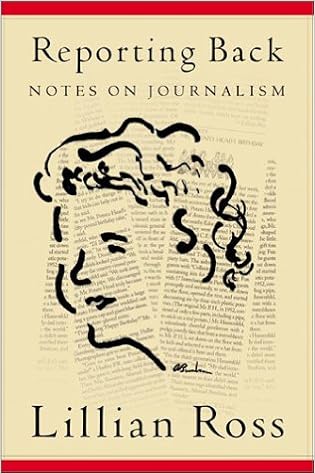
 Lillian Ross wastes no time in conveying to her readers her view on reporting the news .She feels that when reporting the news, one should go about it like creating a film, "that tells a story with a beginning, a middle, and an end,” Ross states in her book Reporting Back: Notes on Journalism. From reading this piece and analyzing that statement it is very clear the Ross is very blunt in her practices as a journalist and is not willing to compromise her beliefs for the sake of money or insincerity. She equates writing about a particular person as a relationship, one that is not to be abandoned or abused.

Ross makes a point that is particularly interesting. She admits to not using a tape recorder when interviewing someone because she finds that "the machine distorts the truth.” She makes a compelling point that I have never given much thought to. Nowadays people tend to live off their phones and laptops, and pay little attention to actually living in the moment and generating their own opinion about things. People are very quick to see what others make of the news and generate their opinions that way, rather than making one’s own sense of news.


 Among Ross’s many tips to aspiring journalists, the best point she makes is when she stresses the importance of listening. Good listening is one of the most crucial aspects of not only being a good journalist, but a good communicator. If you are going to communicate to the rest of the public important happenings in the news, you must possess good listening skills so that you are better able to deliver a more thorough story.

Tuesday, October 27, 2015

Lillian Ross: The Passion of Reporting


By Jessica Mizzi

Lillian Ross, the legendary New Yorker feature writer, has very definite views on how she believes a reporter should act during interviews and writing their articles.  She believes that the “fly on the wall” technique is not to be used, because “a reporter doing a story can’t pretend to be invisible… he or she is seen and heard and responded to by the people he or she is writing about.”  In other words, Lillian argues in Reporting (1964) and in Reporting Back: Notes on Journalism (2002) that reporters should be highly involved in the stories that they cover; they should demonstrate passion towards the people, situations, and events that appeal to them.           

Ross follows these guidelines in her work, adhering to her belief in only writing about things that she likes as “clearly and simply and straightforwardly as possible.”  She trusts her initial response to any person she interviews, and builds her story from there, which I believe to be a very critical aspect of journalism.  In my opinion, reporting is meant to be based on raw, gut feelings, because as Lillian explains, “the first experience--of anything, to me--is the most significant and the most memorable.”   This idea of following your first instinct again contributes to the concept that passion should be involved in reporting.  In addition, she believes that financial reasons should never be the motivation for writing assignments because this limits a writer, disallowing them to pursue what they really want to write about.

Perhaps the most important aspect of reporting that Lillian Ross suggests is listening to the person being interviewed.  She says, “I try to listen while I write, and if I can’t do both simultaneously, my listening takes priority.  Listening is the quintessential word.”  I agree with Lillian that truly listening is the key to writing a well developed story.  Paying attention to details during interviews, and being able to convey important messages and themes in writing is essential to being a successful reporter.

Friday, May 1, 2015

Cecily Strong Speaks Truth Through Jokes at White House Correspondents' Dinner


By Lila Ench

The White House Correspondents’ Dinner on April 26 was shaken up by Saturday Night Live’s take on the news, delivered by Cecily Strong. Many of her jokes had the audience laughing hysterically or sneering hysterically.

“Since I’m only a comedian,” she said to the roomful of Washington elected officials and political journalists, “I’m not going to try and tell you politicians how to do politics or whatever. That’s not my job. That would be like you guys telling me what to do with my body. I mean, can you even imagine?”

She spoke the truth in a way that was light-hearted so even the darkest words could get a laugh.

Cecily Strong is a cast member of Saturday Night Live, who joined as a feature player in 2012. She does a range of impressions, from Colombian-American actress Sofia Vergara to Canadian-American singer Alanis Morrissette. She has also been featured on the comedy program’s Weekend Update, which is probably why she was asked to the host the correspondents’ dinner at the Washington Hilton.

Weekend Update is a satirical segment where two correspondents discuss the news. This type of program is what is necessary for the White House Correspondents’ Dinner, where there needs to be jokes but also moments of genuine critique of President Obama and those who work for him.

Cecily Strong did an incredible job and her jokes hit hard, especially in a time where they need to be heard. Just hours away, Baltimore was experiencing protests due to the death of Freddie Gray, whose spine was nearly severed when he was taken into custody by city police.

“Let’s give it up for the Secret Service,” she said in a commentary on a seemingly national culture of police conduct in targeting African-Americans. “I don’t want to be too hard on those guys, because they’re the only law enforcement agency in the country that will get in trouble if a black man gets shot.”

These comments may be small but they make people think. That is the point of satirical comedy shows, and Cecily did a great job at expressing that. It’s why people watch Saturday Night Live, because they can handle the heavy topics but also allow people to laugh through it.

Cecily Strong is doing a great job not only for Saturday Night Live but for women in general. She is strong, funny, and powerful. There is hope that her presence will open a door for other women who want to speak about hard-hitting topics.

For more information:
https://www.youtube.com/watch?v=uH5XAeKdrjM

Wednesday, April 29, 2015

The Internet: An Idea that Grew to Span the World


By Erin McCarthy

The Internet has transformed the communications world like nothing else has ever before. The Internet is a worldwide mechanism for information broadcasting, and a medium for partnership and interaction between individuals and their computers. The Internet stands for one of the world’s most beneficial ways to research and develop information. The government and the industry have been partners in creating this amazing feature within technology.

This extensive information system is due to of what is called the National Information Infrastructure. The history behind the Internet is extremely complicated and involves many features. These features consist of technological, community and organizational characteristics. The technical fields of computer communications made the influence that the Internet has possible. 

What became the Internet was projected in a series of memos that were the first recorded descriptions of social interactions through computer networking. J.C.R. Licklider, who worked on developing information technology at MIT, wrote these memos in April 1963. In his memos he imagined a globally organized set of computers through which everyone could quickly access data and programs from any site.

This concept was very much like the Internet we have today. He was the head of the computer program at what became the Defense Advanced Research Projects Agency (DARPA). While working at this job he convinced his fellow workers abut the importance of this networking system.

The Internet has changed so much over the two decades in which it came into existence for every day use. The Internet was conceived in an era or time-sharing on massive machines and continued to survive into the era of personnel computers. The most important fact is that the Internet started as a creation of a small band of dedicated researchers. The Internet has since grown to be a commercial success with billions of dollars of yearly revenue.
       
For more information:
http://en.wikipedia.org/wiki/J._C._R._Licklider


Erin McCarthy is a freshman at St. Thomas Aquinas College majoring in Communication Arts. A member of STAC’s softball team, she is extremely interested in sports media.